



Aluminum Honeycomb Core vs Aramid Honeycomb Core: Differences, Properties & Selection Guide
Choosing the right honeycomb core is critical when designing lightweight sandwich panels for aerospace, marine, transportation, RV, furniture, industrial, and architectural applications.
Two of the most widely used lightweight core materials are aluminum honeycomb core and aramid honeycomb core.
Although both materials are designed to reduce weight while maintaining structural performance, they differ significantly in material composition, density, mechanical properties, thermal conductivity, electrical behavior, corrosion resistance, cost, and suitable applications.
In this guide, we compare aluminum honeycomb core vs aramid honeycomb core and explain how to select the right honeycomb core material for your project.
Aluminum Honeycomb Core vs Aramid Honeycomb Core at a Glance
| Property | Aluminum Honeycomb Core | Aramid Honeycomb Core |
|---|---|---|
| Base Material | Aluminum foil | Aramid paper impregnated with resin |
| Typical Materials | 3003, 5052, 5056 aluminum | Aramid fiber paper with phenolic resin |
| Weight | Lightweight | Extremely lightweight |
| Structural Stiffness | Excellent | Good to excellent |
| Compression Performance | Excellent | Excellent relative to weight |
| Shear Performance | High | High strength-to-weight ratio |
| Thermal Conductivity | Relatively high | Low |
| Electrical Conductivity | Conductive | Electrically insulating |
| Corrosion Resistance | Requires proper alloy/surface protection | Non-metallic and corrosion resistant |
| Moisture Resistance | Good with proper treatment | Depends on resin system and sealing |
| Typical Cost | Generally lower | Generally higher |
| Common Applications | RV, marine, truck bodies, rail, architecture, industrial panels | Aerospace, aircraft interiors, UAVs, lightweight composite structures |
The correct material depends on the required balance of weight, stiffness, thermal insulation, electrical insulation, environmental resistance, fire performance, and cost.

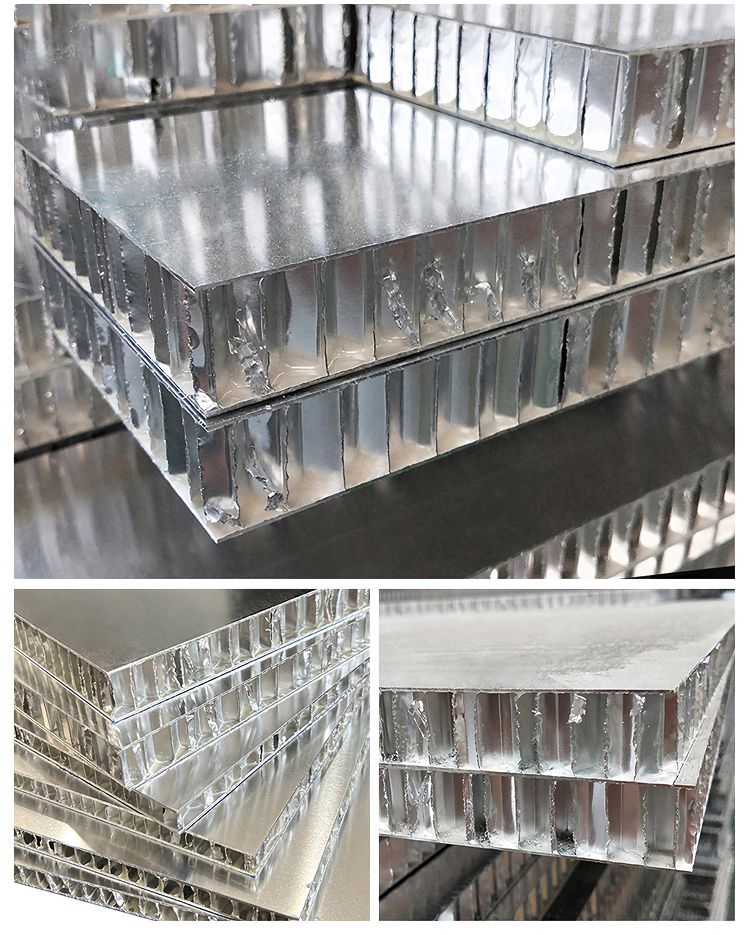
Aluminum honeycomb core is a lightweight structural core made by bonding thin aluminum foil sheets together and expanding them into a hexagonal honeycomb structure.
The geometry creates a very high stiffness-to-weight ratio while keeping the overall panel weight low.
Common aluminum alloys used for honeycomb core include:
- 3003 aluminum
- 5052 aluminum
- 5056 aluminum
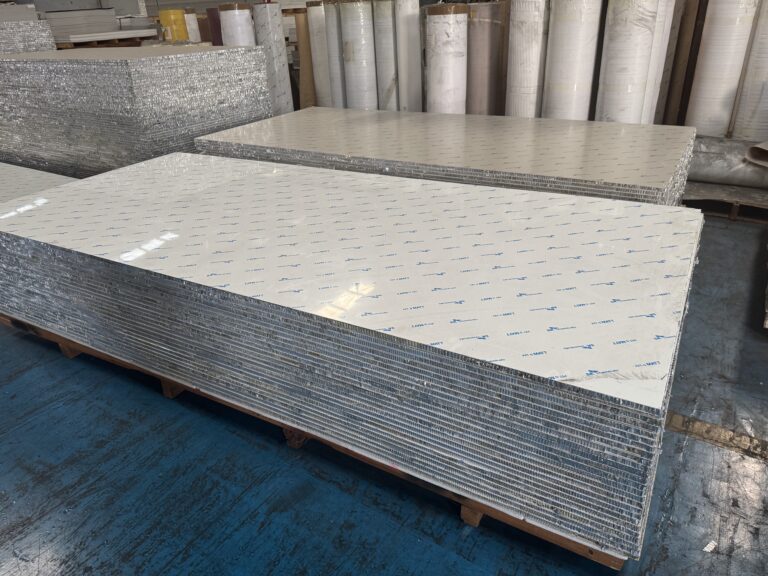
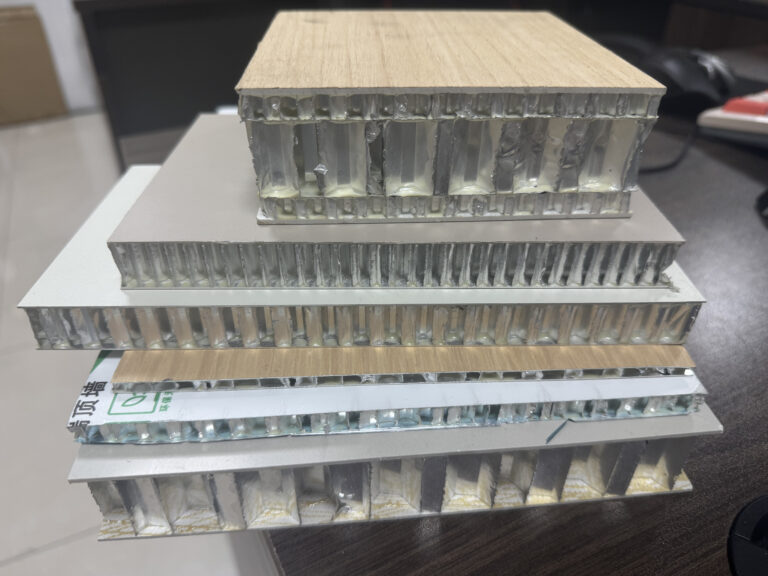
Aluminum honeycomb is commonly bonded between aluminum sheets, fiberglass skins, stone veneers, composite panels, or other facing materials to form a lightweight sandwich panel.
Typical applications include:
- RV and camper panels
- Truck body panels
- Marine and yacht interiors
- Railway interiors
- Building wall panels
- Ceiling panels
- Furniture panels
- Doors
- Industrial partitions
- Equipment enclosures
For applications requiring a rigid, durable and lightweight structural panel, aluminum honeycomb remains one of the most widely used core materials.

Aramid honeycomb core is manufactured from high-strength aramid fiber paper that is formed into a honeycomb structure and typically impregnated with a resin system such as phenolic resin.
It is known for its extremely low weight, good mechanical performance and excellent electrical insulation properties.
Aramid honeycomb is widely used in demanding lightweight composite structures, particularly where every kilogram matters.
Typical applications include:
- Aircraft interiors
- Aerospace structures
- UAV components
- Radomes
- Composite sandwich panels
- Racing vehicles
- High-performance transportation
- Marine structures
- Lightweight interior components
Aramid honeycomb is especially attractive for projects requiring a very high strength-to-weight ratio combined with low thermal conductivity and electrical insulation.
Aramid Honeycomb vs Nomex Honeycomb: Are They the Same?
The terms aramid honeycomb and Nomex honeycomb are often used interchangeably in the industry, but they are not exactly the same.
Aramid honeycomb refers to the general material category.
Nomex® is a well-known aramid material brand developed by DuPont.
Therefore:
- Nomex honeycomb is a type of aramid honeycomb.
- Not all aramid honeycomb should automatically be described as Nomex honeycomb.
When specifying materials for aerospace or technical composite applications, buyers should confirm the exact paper type, resin system, density, cell size and required certification instead of relying only on the general product name.
Aluminum Honeycomb Core vs Aramid Honeycomb Core: 9 Key Differences
1. Material Composition
Aluminum honeycomb is manufactured from thin aluminum foil.
Depending on the application, different aluminum alloys may be selected to achieve the desired combination of strength, corrosion resistance and forming performance.
Aramid honeycomb is produced from aramid fiber paper reinforced with resin.
The two materials therefore behave very differently under thermal, electrical and environmental conditions.
2. Weight and Density
Both materials are lightweight, but aramid honeycomb is generally selected when extremely low structural weight is a priority.
The final core density depends on factors including:
- Cell size
- Foil or paper thickness
- Core density grade
- Core thickness
- Manufacturing process
Aramid honeycomb is particularly common in aerospace structures because significant weight savings can be achieved while maintaining useful mechanical strength.
Aluminum honeycomb is slightly heavier in many comparable configurations but remains very lightweight relative to solid aluminum or other rigid panel structures.
For RVs, marine interiors, truck bodies and furniture, aluminum honeycomb often provides a practical balance between weight, rigidity, cost and production efficiency.
3. Compressive Strength
The honeycomb structure is highly efficient under compression through the thickness direction.
Aluminum honeycomb can offer excellent compressive performance, especially when proper alloy, foil thickness and cell size are selected.
Aramid honeycomb can also provide high compressive strength relative to its density.
However, the exact value should never be determined only by the words “aluminum honeycomb” or “aramid honeycomb.”
Engineering comparison should be based on:
- Core density
- Cell size
- Material grade
- Thickness
- Test direction
- Test standard
- Adhesive system
- Facing material
For engineering projects, actual technical data sheets should be evaluated before making a final material decision.
4. Shear Strength and Structural Stiffness
Shear strength is especially important in sandwich panels because the core transfers loads between the outer skins.
Aluminum honeycomb offers excellent rigidity and dimensional stability, making it suitable for:
- Vehicle panels
- Floors
- Doors
- Cabinet panels
- Wall systems
- Large structural panels
Aramid honeycomb also provides excellent shear performance relative to its weight.
For highly weight-sensitive composite structures, aramid honeycomb can offer a significant advantage.
The final panel performance, however, depends on the entire sandwich construction rather than the honeycomb core alone.
5. Thermal Conductivity
This is one of the major differences between the two materials.
Aluminum is a thermally conductive metal.
Therefore, aluminum honeycomb core has higher thermal conductivity than aramid honeycomb core.
Aramid is a non-metallic material with much lower thermal conductivity.
For applications where thermal insulation is a primary requirement, aramid or other non-metallic cores may offer an advantage.
However, thermal performance should be evaluated based on the complete sandwich panel, including:
- Facing material
- Core
- Adhesive
- Surface coating
- Panel thickness
- Thermal bridge design
For applications such as RV walls or insulated transportation panels, additional insulation layers may be used together with structural honeycomb materials.
6. Electrical and Dielectric Properties
Aluminum honeycomb is electrically conductive.
Aramid honeycomb is electrically insulating.
This difference can be important in:
- Radomes
- Aerospace electronics
- Communication systems
- Electrical enclosures
- High-voltage environments
- Specialized composite structures
For projects requiring dielectric properties, aramid honeycomb is generally more suitable.
For projects where electrical insulation is not a critical requirement, aluminum honeycomb may provide a more economical structural solution.
7. Fire and FST Performance
Fire behavior is particularly important in transportation and aerospace applications.
FST refers to:
- Flame
- Smoke
- Toxicity
It is important to understand that the fire performance of a finished honeycomb sandwich panel cannot be determined from the core material alone.
The result also depends on:
- Facing material
- Adhesive
- Resin system
- Surface coating
- Edge treatment
- Complete panel construction
For projects involving aircraft, trains, marine vessels or public transportation, the complete panel system should be tested according to the relevant project standard.
Do not assume that a honeycomb core automatically guarantees a specific fire classification.
8. Corrosion and Environmental Resistance
Aramid honeycomb is non-metallic and therefore does not suffer from metallic corrosion.
Aluminum honeycomb can provide excellent service life when the correct alloy and protection system are selected.
For marine, coastal and humid environments, attention should be given to:
- Aluminum alloy
- Surface treatment
- Adhesive system
- Edge sealing
- Galvanic corrosion
- Water ingress
- Facing material compatibility
For marine and yacht projects, properly designed aluminum honeycomb sandwich panels can provide excellent durability while reducing weight compared with traditional wood-based construction.
9. Cost
Aluminum honeycomb is generally more economical than high-performance aramid honeycomb.
This makes aluminum honeycomb particularly attractive for commercial projects requiring a combination of:
- Lightweight construction
- Structural rigidity
- Water resistance
- Large panel sizes
- CNC machining
- Cost control
Aramid honeycomb is more commonly selected when performance or weight reduction justifies the higher material cost.
For many commercial RV, truck, marine, furniture and architectural applications, aluminum honeycomb can therefore provide a more cost-effective solution.
3003 vs 5052 Aluminum Honeycomb Core
Not all aluminum honeycomb cores use the same alloy.
Two frequently discussed materials are 3003 aluminum honeycomb core and 5052 aluminum honeycomb core.
3003 Aluminum Honeycomb Core
3003 aluminum offers:
- Good formability
- Good corrosion resistance
- Reliable general-purpose performance
- Competitive cost
It is widely used in commercial honeycomb panels and general industrial applications.
5052 Aluminum Honeycomb Core
5052 aluminum generally offers higher strength and excellent corrosion resistance.
It is commonly considered for more demanding applications such as:
- Marine structures
- Transportation
- Aerospace-related structures
- High-strength lightweight panels
The correct alloy should be selected according to mechanical requirements, environment, panel construction and project standards.
For many projects, alloy selection should be evaluated together with cell size, foil thickness and core density.
Cell Size Matters
Honeycomb cell size affects mechanical performance, surface quality and manufacturing cost.
Smaller cells generally provide:
- More support points beneath the face sheet
- Better surface flatness
- Improved resistance to localized deformation
Larger cells may help reduce weight and cost depending on the application.
Common design factors include:
- Cell diameter
- Foil thickness
- Core density
- Core thickness
- Facing thickness
- Adhesive strength
The correct combination should be selected according to the final panel design rather than evaluating cell size alone.
Applications of Aluminum and Aramid Honeycomb Core
Aerospace and Aircraft
Aramid honeycomb is widely used in aerospace because extremely low weight is a major design priority.
Typical applications include:
- Cabin interior panels
- Floor panels
- Doors
- Overhead compartments
- UAV structures
- Composite components
Aluminum honeycomb is also widely used where high stiffness, temperature resistance or metallic construction is required.
RV and Camper Panels

For RV and camper manufacturers, aluminum honeycomb can be used for:
- Interior wall panels
- Cabinet panels
- Doors
- Furniture
- Floors
- Tables
- Lightweight partitions
Compared with traditional plywood-based systems, aluminum honeycomb structures can help reduce vehicle weight and improve resistance to moisture.
For RV projects, the finished sandwich structure should be designed according to the required load, panel thickness, mounting method and surface material.
Marine and Yacht Applications
Marine interiors benefit greatly from lightweight materials.
Aluminum honeycomb can be used for:
- Yacht furniture
- Cabinet doors
- Interior partitions
- Wall panels
- Ceiling panels
- Flooring structures
- Lightweight doors
For demanding marine projects, corrosion resistance, adhesive selection and edge sealing should all be considered.
Aramid honeycomb may be selected for high-performance vessels where extremely low weight is critical.
Truck Bodies and Transportation
Aluminum honeycomb sandwich panels can be used in:
- Truck bodies
- Utility vehicles
- Commercial vehicles
- Rail transportation
- Lightweight partitions
- Interior structures
Reducing panel weight can help increase payload efficiency while maintaining structural rigidity.
Architectural and Interior Panels
Aluminum honeycomb is widely used in architectural applications such as:
- Wall panels
- Ceiling panels
- Interior partitions
- Doors
- Decorative panels
- Large-format lightweight structures
Its dimensional stability makes it especially suitable for large panels where flatness is important.
Furniture and Cabinetry
Aluminum honeycomb panels are increasingly used as an alternative to plywood, MDF and particleboard in premium lightweight furniture.
Applications include:
- Kitchen cabinets
- Wardrobes
- RV furniture
- Yacht furniture
- Cabinet doors
- Table tops
- Shelving
The material is particularly useful where water resistance, dimensional stability and lightweight construction are important.
UAV and High-Performance Composites
Aramid honeycomb is frequently used in UAVs, drones and advanced composite structures because of its extremely low density.
These applications often combine aramid honeycomb with:
- Carbon fiber
- Fiberglass
- Prepreg composite skins
- High-performance adhesives
Which Honeycomb Core Should You Choose?
Choose aluminum honeycomb core when your project prioritizes:
- High structural rigidity
- Good compression and shear performance
- Commercially competitive cost
- Large panel manufacturing
- CNC machining
- Water-resistant construction
- Vehicle, marine, furniture or architectural applications
Choose aramid honeycomb core when your project prioritizes:
- Extremely low weight
- Electrical insulation
- Low thermal conductivity
- Aerospace-grade lightweight construction
- Carbon fiber composite structures
- High-performance applications
In many cases, there is no universal “better” material.
The best honeycomb core is the one that matches the complete panel design and working environment.
Aluminum Honeycomb Core vs Aramid Honeycomb Core for Sandwich Panels
A honeycomb core should never be selected independently from the panel skins.
Common sandwich structures include:
Aluminum Skin + Aluminum Honeycomb Core
Suitable for rigid, durable and water-resistant panels.
Fiberglass Skin + Aluminum Honeycomb Core
Suitable for transportation and industrial composite panels.
Carbon Fiber Skin + Aramid Honeycomb Core
Suitable for extremely lightweight, high-performance composite structures.
Decorative Surface + Aluminum Honeycomb Core
Suitable for furniture, cabinets, walls, ceilings and interior applications.
The bond between the skin and honeycomb core is also critical to panel performance.
What Information Should You Provide When Ordering Honeycomb Core?
To select the correct honeycomb core, it is helpful to provide the following information:
- Application
- Core material
- Required thickness
- Cell size
- Density
- Aluminum alloy, if specified
- Facing material
- Panel dimensions
- Required quantity
- Drawings
- Required mechanical properties
- Fire or certification requirements
- Operating environment
Providing this information helps the manufacturer recommend a more appropriate material configuration.
Frequently Asked Questions
What is the main difference between aluminum honeycomb and aramid honeycomb?
Aluminum honeycomb is metallic, electrically conductive and generally more economical, while aramid honeycomb is non-metallic, electrically insulating and usually lighter.
Is aramid honeycomb lighter than aluminum honeycomb?
In many comparable high-performance configurations, aramid honeycomb can achieve lower density. However, actual weight depends on cell size, material thickness, density grade and panel design.
Which is stronger, aluminum honeycomb or aramid honeycomb?
There is no universal answer. Mechanical performance depends on core density, cell size, thickness, test direction, material grade and complete sandwich construction.
Is Nomex honeycomb the same as aramid honeycomb?
Nomex is a well-known aramid material brand. Nomex honeycomb belongs to the broader category of aramid honeycomb, but not every aramid honeycomb product should automatically be described as Nomex.
Is aluminum honeycomb waterproof?
Aluminum itself does not absorb water, but the water resistance of the completed sandwich panel also depends on adhesives, skins, joints and edge sealing.
Is aramid honeycomb fire resistant?
Fire performance depends on the aramid paper, resin system and complete sandwich panel construction. Project-specific fire, smoke and toxicity requirements should be verified by testing.
Which honeycomb core is better for aerospace?
Aramid honeycomb is widely used where extremely low weight and dielectric properties are important. Aluminum honeycomb is also used in aerospace structures where metallic stiffness, temperature resistance or other engineering requirements favor aluminum.
Which honeycomb core is better for marine applications?
Both materials can be used. Aluminum honeycomb is often attractive for commercial marine interiors and yacht furniture because of its rigidity and cost-performance balance, while aramid honeycomb may be preferred in high-performance lightweight structures.
Which honeycomb core is suitable for RV panels?
Aluminum honeycomb is widely suitable for RV furniture, walls, doors, floors and interior structures where lightweight construction, moisture resistance and rigidity are important.
Is 3003 or 5052 better for aluminum honeycomb core?
3003 provides good general-purpose performance and cost efficiency, while 5052 generally offers higher strength and excellent corrosion resistance. The correct choice depends on the application and required technical specifications.
Can aluminum honeycomb core be customized?
Yes. Aluminum honeycomb core can generally be customized according to thickness, cell size, density, alloy, dimensions and final sandwich panel requirements.
Need Help Selecting the Right Honeycomb Core for Your Project?
Selecting between aluminum honeycomb core and aramid honeycomb core should be based on your actual application rather than material name alone.
Foshan Meiren Aluminum Co., Ltd. provides customized lightweight honeycomb materials and sandwich panel solutions for applications including:
- RV and camper manufacturing
- Truck bodies
- Marine and yacht interiors
- Lightweight furniture
- Wall and ceiling systems
- Doors
- Transportation
- Industrial composite panels
Send us your required application, dimensions, thickness, cell size, facing material, quantity or technical drawing, and our team can help evaluate a suitable honeycomb structure for your project.