



How to Choose an Aluminum Honeycomb Panel: Structure, Thickness & Core Guide
Choosing an aluminum honeycomb panel is not simply a matter of selecting a panel thickness.
Two aluminum honeycomb panels may both be 18 mm thick, but their weight, rigidity, bonding strength, price and final performance can be very different.
The reason is simple: the performance of an aluminum honeycomb sandwich panel depends on the complete structure, including the aluminum face sheets, honeycomb core, cell size, foil thickness, adhesive system and manufacturing process.
For buyers working on RVs, caravans, truck bodies, marine interiors, furniture, wall systems or other lightweight structures, understanding these specifications can help avoid choosing either an unnecessarily expensive panel or one that is not strong enough for the intended application.
This guide explains the main factors you should consider before ordering an aluminum honeycomb panel.
What Determines the Performance of an Aluminum Honeycomb Panel?
A typical aluminum honeycomb panel consists of several important structural elements:
- Top aluminum face sheet
- Structural adhesive layer
- Aluminum honeycomb core
- Structural adhesive layer
- Bottom aluminum face sheet
The two aluminum skins and the internal honeycomb core work together as a sandwich structure.
The aluminum skins provide the primary surfaces for resisting tension and compression, while the honeycomb core separates and supports the two skins.
This configuration allows the panel to achieve good rigidity while using significantly less material than a solid aluminum plate of similar thickness.
However, the final performance depends on much more than total panel thickness.
When comparing aluminum honeycomb panels, consider:
- Overall panel thickness
- Aluminum skin thickness
- Honeycomb cell size
- Honeycomb foil thickness
- Core density
- Aluminum alloy
- Adhesive system
- Surface treatment
- Panel dimensions
- Manufacturing quality
Understanding these parameters is the first step toward selecting the right panel.
Understanding Aluminum Honeycomb Panel Structure

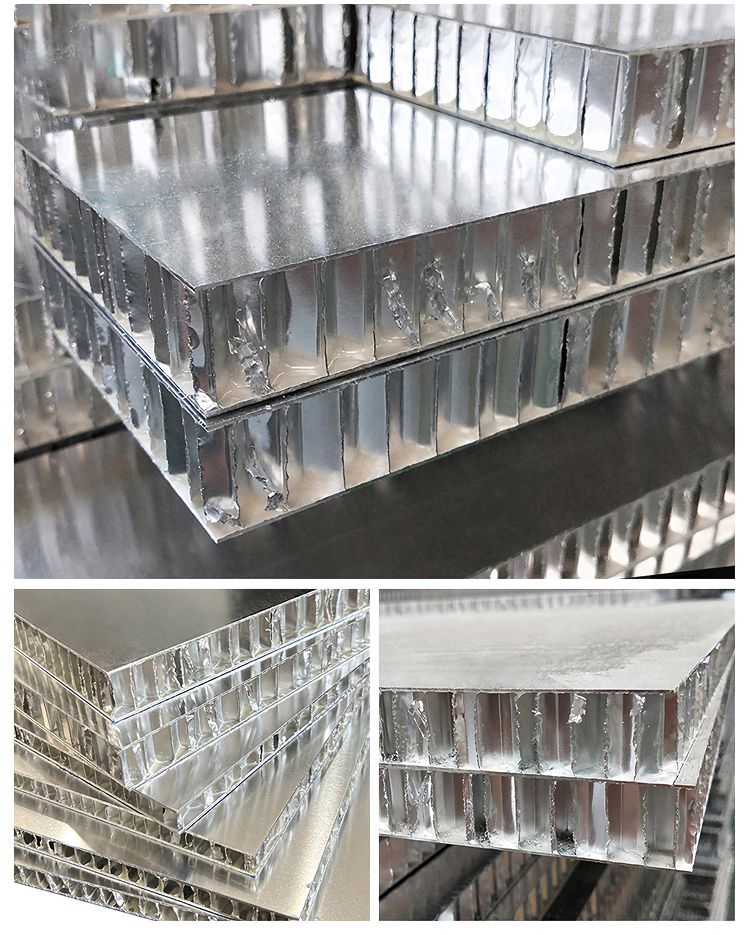
The photo above shows the internal structure of a real aluminum honeycomb panel.
Unlike a solid metal plate, most of the internal volume is occupied by a lightweight cellular structure.
The honeycomb cells distribute loads through interconnected aluminum walls while keeping the amount of material relatively low.
This is one of the main reasons aluminum honeycomb panels provide an attractive strength-to-weight ratio.
The basic structure can be illustrated as:
Aluminum Face Sheet
↓
Adhesive Layer
↓
Aluminum Honeycomb Core
↓
Adhesive Layer
↓
Aluminum Face Sheet
Changing any one of these components may change the final performance.
For example, increasing the face-sheet thickness can increase weight and surface strength, while changing the honeycomb core may affect rigidity, weight and cost.
Therefore, buyers should avoid comparing aluminum honeycomb panels only by overall thickness.
Why Aluminum Skin Thickness Matters
One of the most important specifications is the thickness of the aluminum face sheets.
For example, two suppliers may both offer an 18 mm aluminum honeycomb panel.
However, one structure may use relatively thin aluminum skins, while another uses much thicker aluminum face sheets.
Although the overall panel thickness is identical, these two panels may behave very differently.
Thicker aluminum skins can generally provide:
- Higher surface strength
- Better resistance to localized damage
- Improved screw or hardware support in properly designed structures
- Greater panel weight
- Higher material cost
Thinner skins can help reduce:
- Weight
- Material consumption
- Cost
The correct choice depends on the application.
A lightweight decorative wall panel does not necessarily need the same face-sheet structure as a vehicle body panel or furniture component.
That is why a quotation stating only:
“18 mm aluminum honeycomb panel”
is not enough for a technical comparison.
A more useful specification would include:
Overall thickness + aluminum skin thickness + honeycomb core specification + surface requirement.
How to Choose Aluminum Honeycomb Panel Thickness

Aluminum honeycomb panels can be manufactured in many different overall thicknesses.
Depending on the project, common thickness options may include:
- 8 mm
- 9 mm
- 15 mm
- 18 mm
- 25 mm
- 50 mm
But a thicker panel is not automatically a better panel.
The correct thickness depends on factors such as:
- Required rigidity
- Panel dimensions
- Span between supports
- Expected load
- Required weight
- Hardware installation
- Edge construction
- Final application
For example, a large cabinet door may require more rigidity than a small decorative wall panel.
Similarly, an RV manufacturer may prioritize extremely low weight, while a commercial interior project may place more emphasis on flatness and surface appearance.
The panel should therefore be designed around the application rather than selecting thickness alone.
What Is the Difference Between Overall Thickness and Core Thickness?
This is another area that sometimes causes confusion.
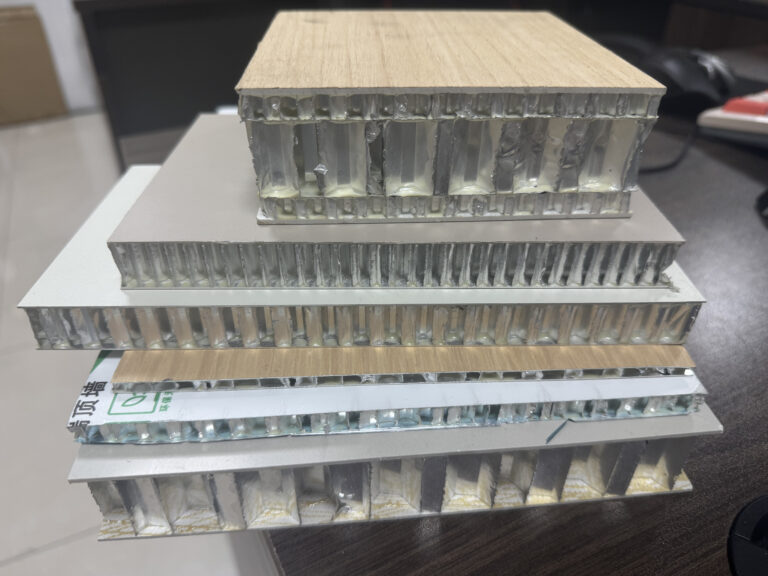
The overall panel thickness includes:
- Top aluminum skin
- Adhesive
- Honeycomb core
- Adhesive
- Bottom aluminum skin
The honeycomb core thickness refers only to the internal honeycomb section.
For example, an 18 mm finished panel does not necessarily contain an 18 mm honeycomb core.
The actual core height must allow for the aluminum skins and bonding layers.
This distinction becomes especially important when panel thickness tolerances are critical, such as:
- Cabinet manufacturing
- CNC machining
- Door production
- Furniture systems
- Vehicle interiors
- Aluminum profiles and edge systems
If the finished panel must fit into a specific profile or hardware system, the required finished thickness tolerance should be confirmed before production.
Why Honeycomb Cell Size Matters
The aluminum honeycomb core is available in different cell sizes.
At Foshan Meiren Aluminum Co., Ltd., different honeycomb structures can be evaluated depending on the product and manufacturing process, including smaller and larger cell configurations.
Examples may include approximately:
- 3 × 3 mm
- 4 × 4 mm
- 5 × 5 mm
Cell size can affect the density, weight, bonding area and mechanical behavior of the honeycomb core.
However, smaller cells are not automatically better for every application.
A suitable honeycomb specification must balance:
strength + weight + cost + manufacturing requirements
For applications requiring lightweight construction, excessive core density may add unnecessary weight.
For other applications, higher structural requirements may justify a different core configuration.
Therefore, cell size should be considered together with:
- Aluminum foil thickness
- Panel thickness
- Face-sheet thickness
- Panel dimensions
- Expected loading
Honeycomb Foil Thickness Is Also Important
Another specification that is easy to overlook is the thickness of the aluminum foil used to manufacture the honeycomb core.
Two honeycomb cores with similar cell sizes may not necessarily have the same density or strength.
Changing the aluminum foil thickness changes the amount of aluminum inside the core.
This can affect:
- Core weight
- Core density
- Compression performance
- Shear performance
- Material cost
For engineering projects, it is therefore better to evaluate the complete honeycomb core specification rather than simply asking whether the panel contains an aluminum honeycomb.
Panel Weight Should Be Evaluated Together With Strength
One of the main reasons customers choose aluminum honeycomb panels is weight reduction.
This is especially important in applications such as:
- RVs
- Caravans
- Campervans
- Trucks
- Commercial vehicles
- Yachts
- Marine interiors
However, making a panel as light as possible is not always the correct objective.
If the aluminum skins become too thin or the internal structure is not suitable for the application, weight may be reduced at the expense of mechanical performance.
A better design objective is:
Achieve the required strength and rigidity at the lowest practical weight.
This is one of the main advantages of sandwich panel engineering.
Instead of simply adding more material, the panel structure can be optimized according to the actual application.
Why Manufacturing Quality Matters

Even when two factories use similar aluminum sheets and honeycomb cores, the finished panels may still perform differently.
Manufacturing quality plays an important role.
Important production factors include:
Adhesive Distribution
The adhesive must be applied consistently across the bonding surface.
Poor adhesive distribution may create areas where the face sheet is not properly bonded to the honeycomb core.
Pressing
The panel must receive suitable and uniform pressure during lamination.
Improper pressing can affect flatness and bonding consistency.
Curing
Structural adhesive requires controlled curing conditions.
The adhesive system, temperature and curing time all influence final bonding performance.
Honeycomb Expansion
The honeycomb core must be expanded and positioned correctly.
Irregular cell geometry can affect panel consistency.
Flatness Control
Large aluminum honeycomb panels require careful control during lamination and curing.
Flatness becomes particularly important for:
- Furniture
- Doors
- Wall systems
- Decorative panels
- CNC-machined components
For this reason, buyers should evaluate both the panel specification and the manufacturer’s production capability.
PUR Bonding and Different Panel Structures
Different adhesive and lamination processes may be used depending on the panel structure and application.
PUR bonding systems can provide good bonding performance for many aluminum composite structures.
However, the adhesive system should be selected according to:
- Aluminum surface
- Decorative surface
- Operating temperature
- Humidity
- Mechanical loading
- Manufacturing process
The adhesive should not be considered separately from the panel structure.
A successful aluminum honeycomb panel depends on the compatibility of the aluminum skins, core, adhesive and manufacturing process.
How to Choose Aluminum Honeycomb Panels for RV and Camper Furniture
Weight is a major concern in RV and campervan design.
Furniture made from conventional wood-based panels can contribute considerable weight to the vehicle interior.
Aluminum honeycomb panels can be considered for components such as:
- Kitchen cabinets
- Wardrobes
- Beds
- Storage cabinets
- Tables
- Doors
- Partitions
For these applications, designers should consider:
- Panel weight
- Screw and hardware installation
- Edge reinforcement
- CNC machining
- Decorative finish
- Cabinet construction method
An 18 mm panel, for example, may be suitable for many furniture concepts, but the final specification should still be selected according to the cabinet design and hardware requirements.
You can also learn more about our RV furniture solutions for lightweight camper and caravan interiors.
How to Choose Panels for Truck and Commercial Vehicle Applications
Commercial vehicles often require materials that combine low weight with rigidity.
Depending on the vehicle structure, aluminum honeycomb panels may be considered for:
- Interior panels
- Partitions
- Doors
- Equipment compartments
- Flooring structures
- Vehicle body components
Vehicle applications may experience:
- Vibration
- Repeated loading
- Temperature changes
- Long-term road use
The panel specification should therefore be selected according to the actual structural requirement rather than using an interior decorative panel specification by default.
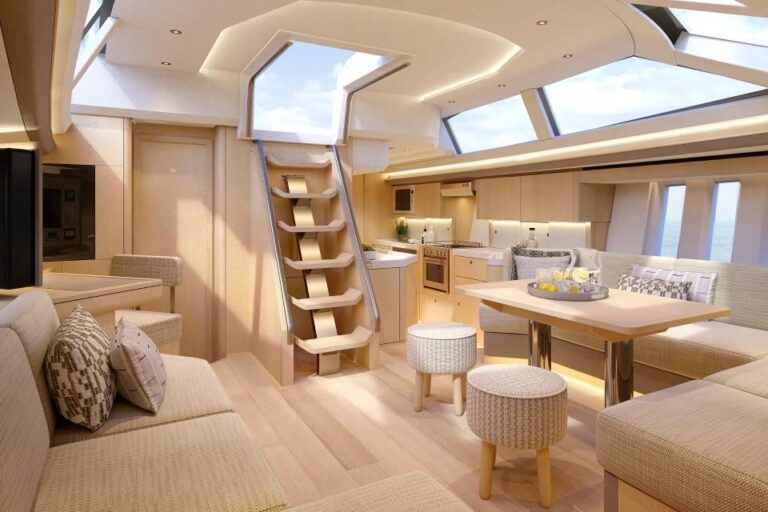
How to Choose Aluminum Honeycomb Panels for Marine Interiors
Marine and yacht interiors place additional demands on materials because of moisture and humidity.
Aluminum does not absorb moisture in the same way as conventional wood-based boards, making aluminum honeycomb structures attractive for lightweight marine interior applications.
Potential applications include:
- Yacht cabinetry
- Interior partitions
- Doors
- Ceiling panels
- Furniture
- Decorative panels
However, marine projects should also consider:
- Aluminum alloy
- Corrosion environment
- Edge protection
- Fasteners
- Contact between dissimilar metals
- Adhesive system
For demanding marine applications, the complete system must be evaluated rather than treating the honeycomb panel as an isolated component.
Aluminum Honeycomb Panels for Wall Systemsv
Aluminum honeycomb panels can also be used as lightweight wall panels.
For wall applications, the priorities may differ from vehicle or furniture applications.
Important considerations include:
- Panel flatness
- Surface appearance
- Installation method
- Joint design
- Panel size
- Weight
- Moisture resistance
For projects requiring an integrated installation system, you can see our aluminum honeycomb wall panels.
Aluminum Honeycomb Panels for Ceiling Systems
Ceiling applications generally benefit from lightweight materials because reducing suspended weight can simplify installation and structural loading.
Aluminum honeycomb ceiling panels can provide a rigid, flat panel while maintaining relatively low weight.
Depending on the project, different surface finishes and panel dimensions can be produced.
More information is available on our aluminum honeycomb ceiling panels page.
Bare Aluminum Honeycomb Panels for Further Processing
Some customers do not require a finished decorative surface.
Instead, they need a structural aluminum honeycomb substrate for:
- Further lamination
- CNC machining
- Furniture manufacturing
- Composite panel development
- OEM production
In these situations, a bare aluminum honeycomb panel can provide a suitable base material for secondary processing.
This allows downstream manufacturers to apply their own decorative surfaces or integrate the panel into a larger product system.
Do Not Compare Aluminum Honeycomb Panels by Price Per Square Meter Alone
This is particularly important for purchasing departments.
If Supplier A quotes a lower price than Supplier B, it does not necessarily mean the same product is being compared.
Before comparing prices, confirm whether the following specifications are equivalent:
| Specification | What to Check |
|---|---|
| Overall thickness | Finished panel thickness |
| Top aluminum skin | Alloy and thickness |
| Bottom aluminum skin | Alloy and thickness |
| Honeycomb cell size | Cell dimensions |
| Foil thickness | Aluminum foil used in the core |
| Core density | Honeycomb structure |
| Adhesive | Bonding system |
| Surface finish | Mill finish, coated or decorative |
| Panel size | Width and length |
| Machining | CNC, drilling or cutting |
| Edge treatment | Open edge, sealed edge or profile |
| Quantity | Production volume |
Only after these specifications are aligned does a direct price comparison become meaningful.
What Information Should You Send to an Aluminum Honeycomb Panel Manufacturer?
If you need a quotation, providing more project information allows the manufacturer to recommend a more suitable structure.
Ideally, send:
- Application
Tell us what the panel will be used for. - Panel size
Length × width. - Overall thickness
For example, 8 mm, 15 mm, 18 mm or 25 mm. - Aluminum skin thickness
If already specified. - Surface finish
Mill finish, decorative surface, coating or custom finish. - Quantity
Approximate square meters or number of panels. - Machining requirements
CNC cutting, drilling, grooves or other processing. - Edge requirements
Open edge, aluminum edge, sealed edge or custom profile. - Weight target
Especially important for RV, vehicle and marine projects. - Mechanical requirements
If the panel will carry structural loads.
If you do not yet know the exact specification, drawings or application information are often enough for an initial evaluation.
Custom Aluminum Honeycomb Panel Specifications
Foshan Meiren Aluminum Co., Ltd. manufactures aluminum honeycomb panels for different OEM and industrial applications.
Depending on project requirements, we can evaluate customized combinations of:
- Panel thickness
- Panel dimensions
- Aluminum skin thickness
- Honeycomb cell size
- Honeycomb foil specification
- Surface finish
- Decorative layer
- CNC processing
- Edge treatment
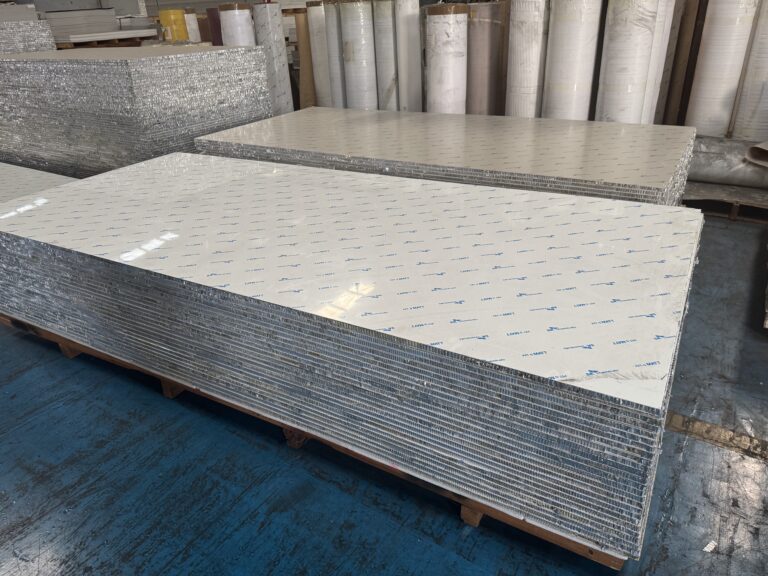
Our commonly produced panel dimensions include formats such as:
1220 × 2440 mm
and
1220 × 2750 mm
with additional customization available according to project requirements.
For custom products, we recommend confirming the complete panel specification before mass production rather than relying only on a generic thickness description.
How to Choose the Right Aluminum Honeycomb Panel
There is no single aluminum honeycomb panel specification that is best for every project.
A suitable panel should balance five main factors:
Strength
The panel must withstand the required load and operating conditions.
Weight
Avoid unnecessary material when lightweight construction is important.
Thickness
Choose the overall thickness according to rigidity, span and product design.
Processing
Consider CNC machining, hardware, edge construction and downstream assembly.
Cost
Use the most efficient structure that meets the technical requirement instead of automatically selecting the heaviest specification.
The correct approach is therefore not:
“Which aluminum honeycomb panel is strongest?”
but rather:
“Which aluminum honeycomb panel provides the required performance at the appropriate weight and cost for this application?”
That is the principle behind effective honeycomb panel selection.
Frequently Asked Questions
What thickness of aluminum honeycomb panel should I choose?
The correct thickness depends on the panel size, required rigidity, loading, application and aluminum skin structure. Overall thickness should not be selected independently from the face-sheet and honeycomb core specifications.
Is a thicker aluminum honeycomb panel always stronger?
Not necessarily. Panel performance also depends on aluminum skin thickness, honeycomb cell size, foil thickness, core density, adhesive and manufacturing quality.
What aluminum honeycomb cell size is best?
There is no universal best cell size. Smaller or larger cells may be selected depending on weight, structural performance, production method and cost requirements.
Is aluminum honeycomb panel suitable for RV furniture?
Yes. Aluminum honeycomb panels are frequently considered for lightweight RV and camper furniture because they can provide useful rigidity with lower weight than many conventional solid materials. Hardware installation and edge construction should be designed according to the furniture system.
Can aluminum honeycomb panels be CNC machined?
Yes. Aluminum honeycomb panels can be cut, drilled and CNC processed according to the panel structure and final component requirements.
Can the surface be customized?
Yes. Depending on the application, aluminum honeycomb panels can use different aluminum surfaces, coatings or decorative finishes.
Can you manufacture custom panel thicknesses?
Yes. Foshan Meiren Aluminum Co., Ltd. can evaluate customized panel thicknesses, skin structures, honeycomb cores and surface configurations according to OEM project requirements.
Need Help Selecting the Right Aluminum Honeycomb Panel?
If you are developing an RV, caravan, truck body, yacht interior, cabinet, wall system or other lightweight aluminum product, do not choose the panel based only on thickness or price.
Send us your:
Application + Drawing + Panel Size + Required Thickness + Quantity
and we can help evaluate a suitable aluminum honeycomb panel structure for your project.
Foshan Meiren Aluminum Co., Ltd.
Website:
www.china-panda-panel.com